-
-
-

Working Towards Justice?
Register to attend EDRA52! Featured project: The Alley Project Detroit, 2011 designed with Detroit Collaborative Design Center and Young Nation. Photo credits: Erik Paul Howard

Support EDRA52!
Help us bridge transdisciplinary border crossings to amplify justice work and community outreach projects. Photo credit:

Discover Detroit
Photo credits: DCDC
Previous Next
Register to Attend EDRA52
We look forward to seeing you in Virtual Detroit.
Photo Credits: DCDC
EDRA52 Virtual Platform
Access the schedule at a glance and virtual platform FAQ.
Sponsors & Exhibitors and Scholarship Opportunities
Help make EDRA52 a success!
Photo credits: DCDC
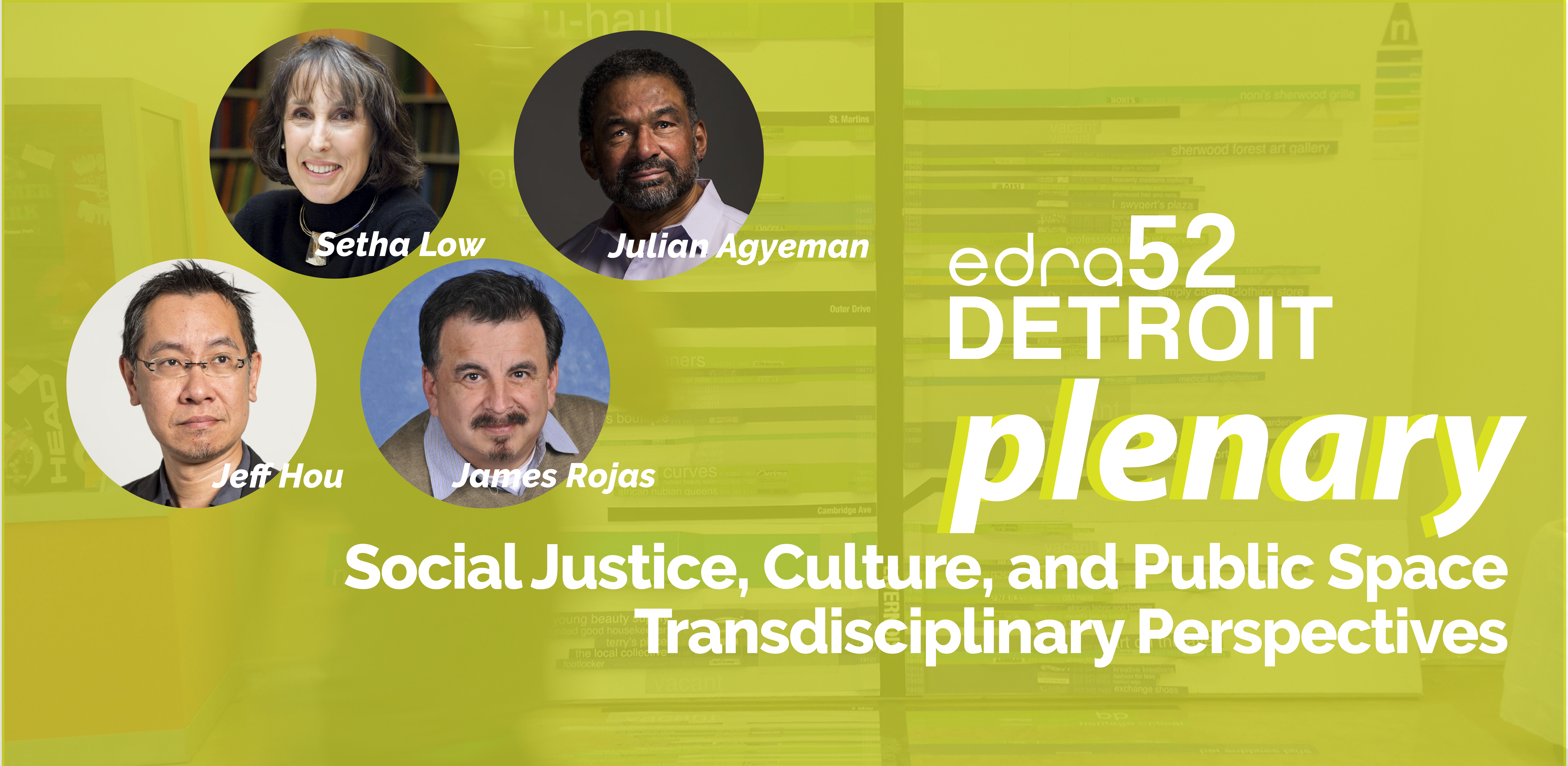
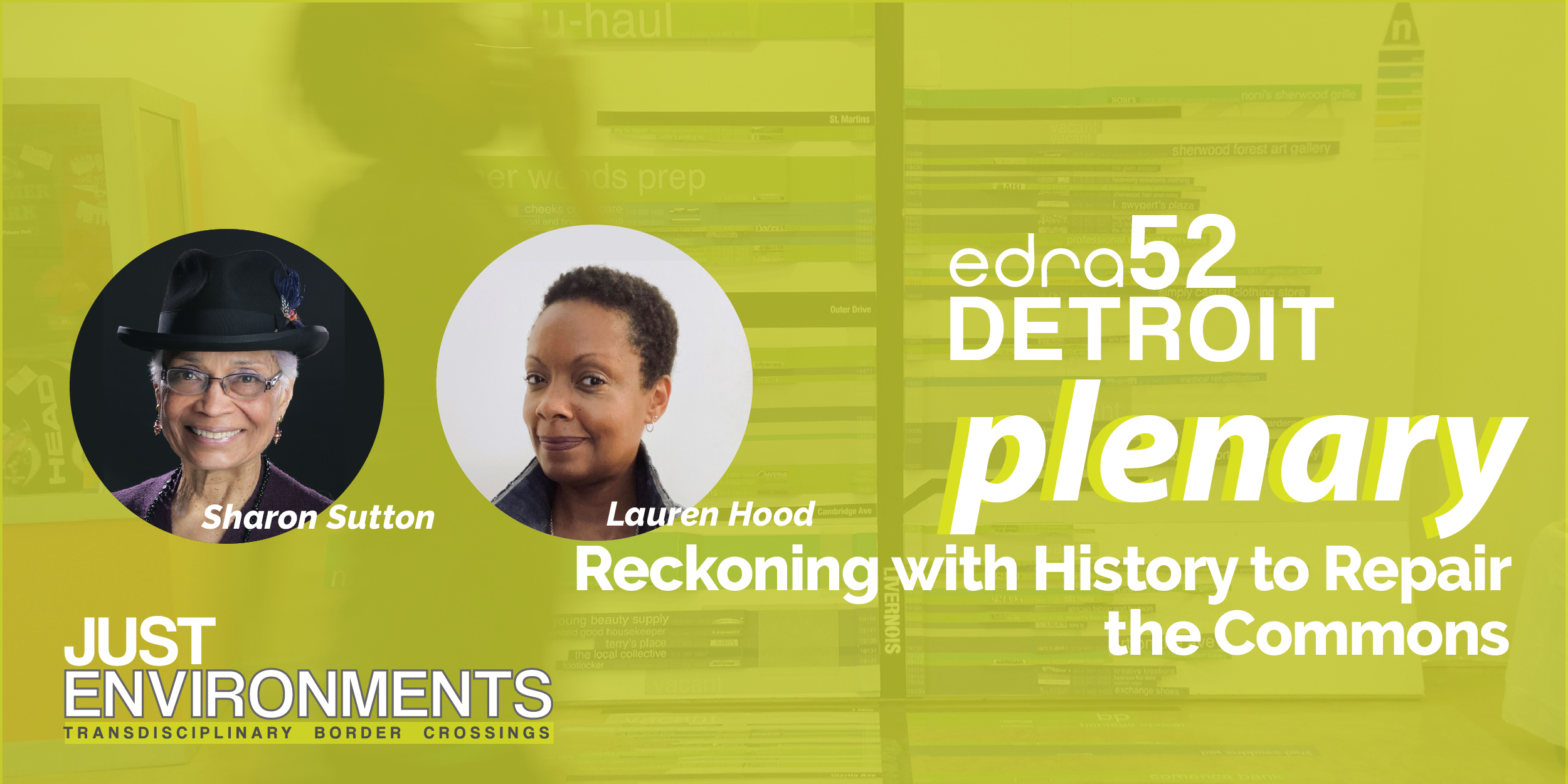
Keynote & Plenaries
Join us at EDRA52 to engage with a variety of renown speakers that will present virtual keynote and plenary sessionss
Photo credits: DCDC
Mobile Sessions
Off-site mobile sessions will engage design and justice in Detroit.
Photo credits: DCDC
Graduate Student Opportunities
Explore scholarship, awards, and events for graduate students pursuing environmental design research at EDRA52Detroit.
Photo credits: EDRA
EDRA52 Awards
We are pleased to offer a variety of awards and recognitions honoring environmental design research and practice.
Photo credits: 2019 Place Research Winner - Great Places Awards
Project credit: Alameda Creek Project submitted
by Brett Snyder
Call for Proposals
Discover our conference topical areas/themes around justice.
EDRA52 Conference Themes
The conference will focus on how research, design, and relationships between people and environments contribute to the creation of justice. Current social, health, environmental, and justice challenges call for collaborative and transdisciplinary
efforts to pursue intentional questioning of disciplinary borders and sensitive approaches to framing and solving pressing contemporary problems through research and practice. Download the
Call for Proposals.
The EDRA52 Detroit conference committee can assist you with questions about your
submission. Just email us at conference@edra.org.
This conference theme invites proposals that explore the theoretical nodes of connection between the physical environment, education, and justice. Speaking specifically from the perspective of Environmental Design education,
we are interested in how theory and methods from different areas of inquiry and diverse disciplinary perspectives can function as fruitful heuristic or framing devices to help contextualize the “problems” taken up by
designers. Successful submissions will describe solutions that can be fashioned in a humane and just way, and in reference to concretely “lived” worlds. We especially invite proposals that draw on a wide variety of
theoretical constructs (e.g., phenomenology, critical race theory, feminism, theories of art and media, social ontology) emanating from the wide spectrum of the social science, humanities, and inter- or transdisciplinary
disciplines that design professionals might draw on in their teaching or mentoring modes.
This conference theme invites proposals that explore the intersections of inclusive community engagement and equitable neighborhood and public space planning to promote just people environments relationships. We are especially
interested in projects focusing on development that reduces racial and economic disparities in underserved communities and promotes sustainable and holistic neighborhoods. Successful proposals will address the social-physical
conditions that marginalize communities and provide evidence of planning and engagement practices that can result in just development. Examples are efforts to expand equitable development through inclusive community
engagement during/post COVID-19, age-friendly neighborhood planning, and development that promotes safety, social interaction, and livability from urban to rural settings and from local to global contexts.
This conference theme invites proposals that share experiences and visions, of just and equitable stewardship of environmental and ecological resources. Environmental and ecological justice are key components of sustainability
politics in the last decades that provide us with the tools to critically investigate the impacts of human activity on climate and environment. This theme focuses on research and methods to address the myriad of injustice
and inequities associated with human interaction with the environment. We welcome inquiries on how to develop and model solutions to environmental problems by integrating the latest technologies and data analyses with
scientific principles through a socio-humanistic lens on human responses. Successful submissions will move beyond demanding equity in the distribution of environmental harms and benefits to look at our relationship
with nature as a means to address social, political, economic, and environmental crises. We are especially interested in topics that address recent environmental contamination and flooding, key concerns in both urban
and natural settings.
This conference theme invites proposals that explore transdisciplinary intersections among theory, research, and practice to promote just relationships between people and environments in terms of social sustainability.
We are especially interested in projects that focus on racial and environmental justice, equity in education, positive youth development, inclusive access to healthcare, aging in place, and safe and secure neighborhoods.
Successful proposals will address the social ecological conditions that shape communities of marginalized people; legitimize contested knowledge from the borders, such as the voices of persons of color, women, and children;
and demonstrate the social ethics/practice of doing what is just. Examples are efforts to expand equitable access to social capital through the innovative design, assessment, or implementation of diverse cultural and
religious environments, recreation and leisure environments, educational and children’s environments, residential and neighborhood environments, healthcare and congregant living environments, or jails and prison environments,
especially in the age of COVID-19.
This conference theme invites proposals that connect race, culture, and identity with issues of power and resistance, diversity of thought, and lived experiences of people in immigrant or marginalized environments, particularly
with regard to displacement and mobility. Is community heritage-based or place-based? Can it exist without physical space tied to it? How can community be preserved when one is uprooted? How can cultural memory create
place and space in placemaking and place-keeping? How do bilingualism and/or biculturalism affect or inform access, movement, and mobility, create awareness of circumstance and room for dialogue, and opportunity to
change the power structure? We are especially interested in submissions that equally emphasize material culture (built environments, public spaces, artifacts) and immaterial culture (practices, representations, language,
rituals, festivals, and artistic expressions) that can help us find new ways to connect with community and new ways to design with history and migration in mind.
This conference theme invites proposals that address sustainability and resiliency in the just design and preservation of place. The built environment has not evolved by chance, but rather through customs, cultural traditions,
and material and physical resources that are often intrinsic to their place. Our built environments become a simultaneous physical record of who we were and who we are. How does this past legacy, in conjunction with
the desires of its patrons, impact how we understand place and space? We are interested in submissions that reflect on outcomes of design decision-making processes and consider the methods, different tools, historic
strategies, and the acts of making that yield just environments. What codifications are being intentionally deployed and which are patterns that we empower based on a lack of consciousness in the spaces that we inhabit—from
the layout of a prison cell to a café, an emergency room, or a public park; from the design of a working space to a learning space; from the scale of a neighborhood or development to a master plan?
This conference theme invites proposals that address sustainability and resiliency in the just design and preservation of place. The built environment has not evolved by chance, but rather through customs, cultural traditions,
and material and physical resources that are often intrinsic to their place. Our built environments become a simultaneous physical record of who we were and who we are. How does this past legacy, in conjunction with
the desires of its patrons, impact how we understand place and space? We are interested in submissions that reflect on outcomes of design decision-making processes and consider the methods, different tools, historic
strategies, and the acts of making that yield just environments. What codifications are being intentionally deployed and which are patterns that we empower based on a lack of consciousness in the spaces that we inhabit—from
the layout of a prison cell to a café, an emergency room, or a public park; from the design of a working space to a learning space; from the scale of a neighborhood or development to a master plan?
This conference theme invites proposals seeking to connect social issues to the design of human technology interactions and promote justice in both built and virtual environments. How can technology help redefine justice?
We are particularly interested in proposals that redefine notions of race, gender, class, sexual orientation, ability, health, age, and other social constructs and their implications on technologies that promote social
equity. Examples of projects that influence the design, access, and use of technology in human environments, and in turn, are reproduced and reconstructed through technological innovations include the design and application
of assistive and medical devices, technologies of surveillance, biotechnologies of reproduction, human-computer interfaces, artificial intelligence algorithms, human-computer interface in education, recreation, and
communication. We also welcome proposals that investigate the role of technoscientific innovations, such as prosthetic devices, prenatal diagnostic techniques, extended reality, robotic systems, Internet of Things (IOT),
ergonomic designs, and DNA profiling.
key dates*
Call for proposals released
Submission portal opens join us!
Due date for all Intensives, Abstracts (individual and group presentations), and Full Papers
Due date for Mobile Sessions
Due date for Graduate Student Mentoring Workshop Applications
Early Bird Registration Opens
Due date for Work in Progress - Abstracts and Visual Presentation Abstracts (Poster Abstracts and Video Shorts)
Regular registration begins/Early Bird registration ends
Mentor applications for GSMW due
Final date to register for the conference
conference presenters to be included in the EDRA52 program
Poster digital copy due
All virtual materials due (session pre-recorded presentations, Digital Media Shorts)
The making of just environments requires us to question what goes into conceiving, creating, building, nurturing, and sustaining justice as we negotiate new ways of interacting in public space. The very concept of public
space has become contested and occupied by global protests. How we navigate these new spatial and ideological environments raises several questions: What makes a just environment in a world where democracy is threatened?
What is the time and space of environments, and of justice? How can environments be integrated into the social world and values of freedom, equality, and liberation? What forecloses this possibility? What are the prospects
of utopian imaginings in uncertain and revolutionary times? The conference will provide a platform to explore issues of justice in the environment in relation to social, cultural, and economic sustainability; race and
culture; education, workplace, and recreation; youth and aging; health and wellness; equality in planning, policy making, and public space design; physical border conditions, urban fragmentation and divisions; practices
of inclusion and community engagement; intersections of justice and ecological sustainability; accessibility and mobility; environmental and community shared resources; pressing global displacement and migration issues;
philosophical and ethical concerns; and the necessity of creating social, built, and natural environments in support of a just future.
Transdisciplinary methods are increasingly used to address challenges facing the globe, such as climate change, poverty, equitable development, that require both disciplinary and global border crossings. Transdisciplinary
methods, by definition, require us to operate collectively at the boundary and across boundaries – facilitating the creation of “net new” methods and outcomes to create new knowledge and solutions to “wicked” problems.
We invite proposals that address the hybridity, complexity, and dynamics of transdisciplinary collaboration. We are especially interested in research and practice that expand disciplinary boundaries and identify new
territories for design agency and action while simultaneously embracing local contexts, being oriented toward action, and addressing contemporary societal problems.
African American studies
Anthropology
Architecture
artificial intelligence
behavioral science
biological sciences
Business
behavioral science
biological sciences
Business
civil engineering
Communication
community development
computer science
Counseling
criminal justice
Design
Ecology
Economics
Education
Engineering
environmental science
ethnic studies
family studies
Geography
Gerontology
global/cultural studies
health sciences
healthcare design
historic preservation
Horticulture
Housing
interior design
landscape architecture
Literature
Philosophy
physical sciences
political science
Psychology
public administration
public art
public health
public interest design
public policy
religious studies
science & technology studies
Sociology
soil science
transportation design
urban planning
urban design
urban studies
women's & gender studies
EDRA52 Conference Manager
Claire Antrassian
Architectural Designer Quinn Evans Architects
EDRA52 Project Assistant
Natalie Malouf
Junior Designer Allegretti Architects
EDRA52 Conference Chair
Claudia Bernasconi
Associate Professor, School of Architecture, University of Detroit Mercy EDRA Board of Directors EDRA Program Committee Chair
EDRA52 Conference Co-Chairs
Libby Blume
Emerita Professor, College of Liberal Arts and Education, University of Detroit Mercy
Tadd Heidgerken
Assistant Professor, School of Architecture, University of Detroit Mercy
Toni Henry
Designer & Project Manager, Detroit Collaborative Design Center, University of Detroit Mercy
James Leach
Assistant Professor, School of Architecture, University of Detroit Mercy
EDRA52 Conference Co-Chairs Continued..
Erika Lindsay
Assistant Professor, School of Architecture, University of Detroit Mercy
Carol Miller
Professor, School of Engineering, Wayne State University
Kris Nelson
Assistant Professor, School of Architecture, University of Detroit Mercy
Felice Gianluca Sperone
Lecturer, College of Liberal Arts, Wayne State University
Noah Resnick
Associate Dean, Professor, School of Architecture, University of Detroit Mercy
EDRA 52 Conference Student Helpers
Mona Makki
University of Detroit Mercy
Hanen Mohammad
University of Detroit Mercy
Grace Cooley
University of Detroit Mercy
Taylor Tomman
University of Detroit Mercy
Dristy Shajnin
University of Detroit Mercy
Thank You to Our Sponsors.
We are grateful to our sponsors that help make EDRA52 a success.
|